
Answer Part 2: Subnet Design Exercise
Today’s post picks up the discussion of the solution to the subnet design exercise I posted a while back. Start with the post for the original problem statement, and read from there!
The third requirement stated that the WAN subnets should use the two numerically lowest subnet IDs. Without any reason to avoid it, the zero subnet (172.16.0.0) should be used. So, the R1-R2 link will use that subnet, and the R2-R3 link will use 172.16.2.0.
The fourth requirement states that the 3 numerically-highest subnets should be the R1 LAN, R2 LAN, and R3 LAN, in that order. Just pick those from the list. The final choices for the subnet then are:
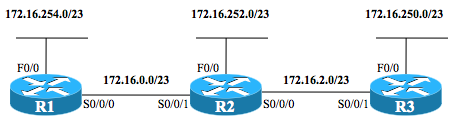
R1-R2 WAN: 172.16.0.0
R1-R3 WAN: 172.16.2.0
R1 LAN: 172.16.254.0
R2 LAN: 172.16.252.0
R3 LAN: 172.16.250.0
To meet the firth requirement, you need to find the range of addresses in each subnet, which then tells you the last IP address in each subnet. The configuration at that point should not be a stretch. Examples 1, 2, and 3 show the resulting configuration on routers R1, R2, and R3.
Example 1: R1 Configuration
interface F0/0
 ip address 172.16.255.254 255.255.254.0
!
interface S0/0/0
 ip address 172.16.1.253 255.255.254.0
Example 2: R2 Configuration
interface F0/0
 ip address 172.16.253.254 255.255.254.0
!
interface S0/0/1
 ip address 172.16.1.254 255.255.254.0
!
interface S0/0/0
 ip address 172.16.3.253 255.255.254.0
Example 3: R3 Configuration
 interface F0/0
 ip address 172.16.251.254 255.255.254.0
!
interface s0/0/1
 ip address 172.16.3.254 255.255.254.0